<?xml version="1.0" encoding="utf-8"?><?xml-stylesheet type="text/xsl" href="atom.xsl"?>
<feed xmlns="http://www.w3.org/2005/Atom">
    <id>https://quinnmchugh.net/blog-micro</id>
    <title>Quinn McHugh's Micro Blog</title>
    <updated>2025-01-27T00:28:14.000Z</updated>
    <generator>https://github.com/jpmonette/feed</generator>
    <link rel="alternate" href="https://quinnmchugh.net/blog-micro"/>
    <subtitle>A microblog of miscellaneous musings, tips, and thoughts from Quinn McHugh</subtitle>
    <icon>https://quinnmchugh.net/img/favicon.ico</icon>
    <rights>Copyright © 2017-2025 Quinn McHugh</rights>
    <entry>
        <title type="html"><![CDATA[]]></title>
        <id>https://quinnmchugh.net/blog-micro/Welcome</id>
        <link href="https://quinnmchugh.net/blog-micro/Welcome"/>
        <updated>2025-01-27T00:28:14.000Z</updated>
        <summary type="html"><![CDATA[This is my microblog. It consists of random ideas, tips, and musings from my everyday life.]]></summary>
        <content type="html"><![CDATA[<p>This is my microblog. It consists of random ideas, tips, and musings from my everyday life.</p>
<p>Some of these "seedling" posts may grow into larger blog posts.</p>]]></content>
        <author>
            <name>Quinn McHugh</name>
        </author>
    </entry>
    <entry>
        <title type="html"><![CDATA[Candidate Breadth v.s. Depth]]></title>
        <id>https://quinnmchugh.net/blog-micro/2024/03/23/2024/candidate-breadth-vs-depth</id>
        <link href="https://quinnmchugh.net/blog-micro/2024/03/23/2024/candidate-breadth-vs-depth"/>
        <updated>2024-03-23T00:00:00.000Z</updated>
        <summary type="html"><![CDATA[One aspect of hiring/interviewing I've been thinking about:]]></summary>
        <content type="html"><![CDATA[<p>One aspect of hiring/interviewing I've been thinking about:</p>
<p>I have a hunch that hiring processes tend to focus more on a candidate's <em>depth</em> of knowledge in a select number of areas than the total questionably relevant <em>breadth</em> of knowledge they possess.</p>
<p>This makes sense because it's a form of measurability bias - it's hard to assess skills and experience that don't seem relevant to the immediate role being hired for, but that seemingly irrelevant blend of expertise could be the thing that enables that candidate to have outsized impact relative to other candidates. You can think of a candidate's breadth of knowledge can be an loose proxy for level of creativity and capacity to innovate. It's easier to produce good ideas when you have a lot of other ideas (from both similar and dissimilar domains) to take inspiration from.</p>
<p>This doesn't apply to all roles, of course, but I do think it's something worth thinking about.</p>]]></content>
        <author>
            <name>Quinn McHugh</name>
        </author>
        <category label="Hiring" term="Hiring"/>
        <category label="Innovation" term="Innovation"/>
        <category label="Creativity" term="Creativity"/>
    </entry>
    <entry>
        <title type="html"><![CDATA[Get Feedback: A goal everyone should have]]></title>
        <id>https://quinnmchugh.net/blog-micro/2024/03/13/2024/get-feedback</id>
        <link href="https://quinnmchugh.net/blog-micro/2024/03/13/2024/get-feedback"/>
        <updated>2024-03-13T00:00:00.000Z</updated>
        <summary type="html"><![CDATA[Of all the unique and diverse goals you could have in your life, one of them should be this:]]></summary>
        <content type="html"><![CDATA[<p>Of all the unique and diverse goals you could have in your life, one of them should be this:</p>
<p><strong>Get feedback</strong></p>
<p>This advice applies to anyone at any stage of life, whether you're a CEO, a student, a senior researcher, a parent, an early career professional, or retired.</p>
<ul>
<li>Not sure what next step to take in your career? <strong>Get feedback</strong> . Identify projects or work opportunities that could give you insight into what you actually like and don't like to do. Ended up being a terrible experience? Good. You now understand what to avoid or do differently in the future.</li>
<li>Not sure if you're qualified for that job? <strong>Get feedback</strong>. Apply anyway. You got rejected? Good. Get more feedback. Reach out to the employer and ask for input about your application. You now have valuable intel on what skills you might be lacking or what other jobs might be a better fit.</li>
<li>Not sure why your company's failing? <strong>Get feedback</strong>. Talk with employees across <em>every level</em> of your organization and understand what they think the problems are and what might be done to solve them. Develop a new strategy based on this input.</li>
<li>Not sure if your parenting style is working for your kids? <strong>Get feedback</strong>. Talk candidly about the kind of parent you want to be and ask in what ways you have/haven't support them.</li>
<li>Not sure if you're doing well as a manager? <strong>Get feedback</strong>. Ask your colleagues to rate how well you're doing and ask: "what could I do to increase that score by one point?"</li>
<li>Feeling like you lack expertise? <strong>Get feedback</strong>. Teach what you know to identify gaps in your knowledge.</li>
</ul>
<p>All of this boils down to 5 steps:</p>
<ol>
<li>Identify your goal</li>
<li>Identify one or more actions you might take to achieve your goal</li>
<li>Do those actions</li>
<li>Get feedback on your performance in carrying out those actions</li>
<li>Go back to step 2</li>
</ol>
<p>Feedback is an essential component of every well-performing complex system (you). It provides the information needed to adjust your behavior to produces the desired outcomes.</p>
<p>Stop ruminating about what <em>might</em> be true and get feedback to better understand what <em>actually is</em>.</p>]]></content>
        <author>
            <name>Quinn McHugh</name>
        </author>
        <category label="Goals" term="Goals"/>
        <category label="Feedback" term="Feedback"/>
        <category label="Systems" term="Systems"/>
    </entry>
    <entry>
        <title type="html"><![CDATA[Scopeboxing]]></title>
        <id>https://quinnmchugh.net/blog-micro/2024/03/10/2024/scopeboxing</id>
        <link href="https://quinnmchugh.net/blog-micro/2024/03/10/2024/scopeboxing"/>
        <updated>2024-03-10T00:00:00.000Z</updated>
        <summary type="html"><![CDATA[One paradoxical aspect of innovation - to increase your creativity or output, it's a good idea to decrease your creative bounds.]]></summary>
        <content type="html"><![CDATA[<p>One paradoxical aspect of innovation - to increase your creativity or output, it's a good idea to <em>decrease</em> your creative bounds.</p>
<p>For example:</p>
<ol>
<li><strong>Timeboxing</strong> - Limiting the time you have to execute a task, helping reduce the effect of Parkinson's Law (the tendency for work to expand to the time allotted for its completion)</li>
<li><strong>Sizeboxing</strong> - Limiting the physical size in which you can produce work e.g. limiting your essays to the screenshot of a phone, writing individual notes on 4x6 index cards, record a song with only two instruments, paint on canvas no more than 4x4 inches.</li>
<li><strong>Scopeboxing</strong> - Limiting the scope of ideas you're allowed to produce e.g. "If I was the only one working on this project, what kinds of risks would I focus on mitigating?"</li>
</ol>]]></content>
        <author>
            <name>Quinn McHugh</name>
        </author>
        <category label="Creativity" term="Creativity"/>
        <category label="Innovation" term="Innovation"/>
    </entry>
    <entry>
        <title type="html"><![CDATA[Build a fence around your solution]]></title>
        <id>https://quinnmchugh.net/blog-micro/2024/03/09/2024/build-a-fence-around-your-solution</id>
        <link href="https://quinnmchugh.net/blog-micro/2024/03/09/2024/build-a-fence-around-your-solution"/>
        <updated>2024-03-09T00:00:00.000Z</updated>
        <summary type="html"><![CDATA[Marketing protip: When communicating your idea or solution, make sure to touch upon how it is different from anything existing your users might have heard of.]]></summary>
        <content type="html"><![CDATA[<p>Marketing protip: When communicating your idea or solution, make sure to touch upon how it is <em>different</em> from anything existing your users might have heard of.</p>
<p>I've come across numerous ideas, products, approaches, or other innovations that thoroughly explain what they are are how they work, but don't explicitly tell the users what it <em>adds</em> the existing solution space.</p>
<p>Why is this important?</p>
<ul>
<li>It streamlines knowledge transfer - some of your potential users/supporters already have a good conceptual model of solutions similar to yours. Explaining how your idea relates to these makes it that much easier for them to understand what you bring to the table, leveraging the cognitive scaffolding they've already built.</li>
<li>It makes a positive impression - communicating in this way signals that you already have a good understanding existing solutions. As a potential user, this gives me greater confidence that what you offer is actually better than the competition</li>
<li></li>
</ul>]]></content>
        <author>
            <name>Quinn McHugh</name>
        </author>
    </entry>
    <entry>
        <title type="html"><![CDATA[Thoughts on local climate giving]]></title>
        <id>https://quinnmchugh.net/blog-micro/2024/02/22/2024/thoughts-on-local-climate-giving</id>
        <link href="https://quinnmchugh.net/blog-micro/2024/02/22/2024/thoughts-on-local-climate-giving"/>
        <updated>2024-02-22T00:00:00.000Z</updated>
        <summary type="html"><![CDATA[Following the last Green Drinks Philly meetup, an attendee reached out to me, asking for my thoughts on the most impactful climate-focused organizations to contribute to here in the Philly area.]]></summary>
        <content type="html"><![CDATA[<p>Following the last <a href="https://www.greendrinks.org/PA/Philadelphia" target="_blank" rel="noopener noreferrer">Green Drinks Philly meetup</a>, an attendee reached out to me, asking for my thoughts on the most impactful climate-focused organizations to contribute to here in the Philly area.</p>
<p>While I don't claim to be an expert in climate giving, I wanted to share my thoughts, in case it might benefit anyone else grappling with similar questions:</p>
<p><span role="img" aria-label="keycap: 1">1️⃣</span> If you're thinking about the impact of your donations, kudos!!!!!! <span role="img" aria-label="clapping hands">👏</span><span role="img" aria-label="clapping hands">👏</span><span role="img" aria-label="clapping hands">👏</span> You're already on a great path towards having more impact.</p>
<p><span role="img" aria-label="keycap: 2">2️⃣</span> My default answer to "where should I give locally?" is to turn it around and ask: "is there a particular reason you want to give locally?"</p>
<p>The most cost-effective interventions within a given cause (e.g. climate, global health, education, etc) are often orders of magnitude more cost-effective than the average. Thus, by limiting your scope, you may ultimately be limiting your impact. It's valuable to consider the underlying reason you want to donate to a local organization, given the amount of good your money could do elsewhere. This is not to say that you're wrong for deciding to give locally (there are perfectly valid reasons for doing so!). What matters most is that your decision is made thoughtfully and intentionally.</p>
<p><span role="img" aria-label="keycap: 3">3️⃣</span> If you're interested in giving beyond your immediate area, there are two charities I would recommend checking out:</p>
<ul>
<li>
<p><strong><a href="https://www.founderspledge.com/funds/climate-change-fund" target="_blank" rel="noopener noreferrer">Founders Pledge Climate Change Fund</a></strong> - Founder's Pledge advises entrepreneurs on high-impact giving. Donating to their climate change fund puts your money into a pool that is strategically allocated by philanthropic experts. The drawback of charity funds is that it can feel like your money is being thrown into a black box that someone else ultimately decides what to do with. If you'd rather have 100% control over where your donations go, you might turn to a charity evaluator like…</p>
</li>
<li>
<p><strong><a href="https://www.givinggreen.earth/" target="_blank" rel="noopener noreferrer">Giving Green</a></strong> - Giving Green is a charity dedicated to helping individuals and businesses make more effective climate-giving decisions. They specialize in finding evidence-based, cost-effective, and high-leverage organizations that maximize the impact of your climate donations. See their recommended non-profits here: <a href="https://www.givinggreen.earth/top-climate-change-nonprofit-donations-recommendations" target="_blank" rel="noopener noreferrer">https://www.givinggreen.earth/top-climate-change-nonprofit-donations-recommendations</a></p>
</li>
</ul>
<p><span role="img" aria-label="keycap: 4">4️⃣</span> When it comes to local organizations, it's probably best to do your own research (and publish your findings for the rest of us!) For starters, you might consider researching organizations like the <a href="https://cleanair.org/" target="_blank" rel="noopener noreferrer">Clean Air Council</a>, <a href="https://www.pennfuture.org/" target="_blank" rel="noopener noreferrer">PennFuture</a>, <a href="https://environmentamerica.org/pennsylvania/" target="_blank" rel="noopener noreferrer">Penn Environment</a>, or <a href="https://cleanwater.org/" target="_blank" rel="noopener noreferrer">Clean Water Action</a>.</p>
<p>For finding additional charities, you might also consider browsing the City of <a href="https://www.phila.gov/departments/office-of-sustainability/publications/" target="_blank" rel="noopener noreferrer">Philadelphia Office of Sustainability's publications</a> or the <a href="https://www.impact.upenn.edu/resources-for-identifying-and-researching-nonprofits-to-support/" target="_blank" rel="noopener noreferrer">Penn Center for High Impact Philanthropy's webpage on identifying and researching nonprofits to support</a>.</p>
<p>What did I miss? I'd love to hear your thoughts below.</p>]]></content>
        <author>
            <name>Quinn McHugh</name>
        </author>
    </entry>
    <entry>
        <title type="html"><![CDATA[Deliberating limiting your Slack message history]]></title>
        <id>https://quinnmchugh.net/blog-micro/2024/02/21/2024/slack-policy-message-expiration-date</id>
        <link href="https://quinnmchugh.net/blog-micro/2024/02/21/2024/slack-policy-message-expiration-date"/>
        <updated>2024-02-21T00:00:00.000Z</updated>
        <summary type="html"><![CDATA[Heard an interesting idea on the Thoughtworks Technology Podcast:]]></summary>
        <content type="html"><![CDATA[<p>Heard an interesting idea on the Thoughtworks Technology Podcast:
Set an expiration date for messages in your team's Slack workspace - this creates an incentive to add important info to a wiki or decision log.
<a href="https://share.snipd.com/snip/9b03d4ff-c75c-458b-8946-e3274b6b678b" target="_blank" rel="noopener noreferrer">https://share.snipd.com/snip/9b03d4ff-c75c-458b-8946-e3274b6b678b</a></p>
<p>Agree or disagree?</p>]]></content>
        <author>
            <name>Quinn McHugh</name>
        </author>
        <category label="Slack" term="Slack"/>
        <category label="Knowledge Management" term="Knowledge Management"/>
        <category label="Incentives" term="Incentives"/>
    </entry>
    <entry>
        <title type="html"><![CDATA[Resources in Response to OpenAI's Sora Announcement]]></title>
        <id>https://quinnmchugh.net/blog-micro/2024/02/18/2024/resources-in-response-to-open-ai-sora-announcement</id>
        <link href="https://quinnmchugh.net/blog-micro/2024/02/18/2024/resources-in-response-to-open-ai-sora-announcement"/>
        <updated>2024-02-18T00:00:00.000Z</updated>
        <summary type="html"><![CDATA[I've noticed a large spectrum of reactions to OpenAI's Sora announcement, ranging from complete awe to existential dread. However you're processing the news, please know that it's entirely normal to feel a range of emotions in response to such significant technological developments. Emotions are complex, and it's important to give yourself the time to feel them without judgment and seek out others who might be able to provide mutual support. With this in mind, I wanted to share the following resources, which might provide solace and new perspective during this time:]]></summary>
        <content type="html"><![CDATA[<p>I've noticed a large spectrum of reactions to <a href="https://openai.com/sora" target="_blank" rel="noopener noreferrer">OpenAI's Sora announcement</a>, ranging from complete awe to existential dread. However you're processing the news, please know that it's entirely normal to feel a range of emotions in response to such significant technological developments. Emotions are complex, and it's important to give yourself the time to feel them without judgment and seek out others who might be able to provide mutual support. With this in mind, I wanted to share the following resources, which might provide solace and new perspective during this time:</p>
<ol>
<li>ActiveHope.Training: <a href="https://activehope.training/" target="_blank" rel="noopener noreferrer">https://activehope.training/</a></li>
<li>"Another Way to Be Okay" by Gretta Duleba: <a href="https://www.lesswrong.com/posts/SKweL8jwknqjACozj/another-way-to-be-okay" target="_blank" rel="noopener noreferrer">https://www.lesswrong.com/posts/SKweL8jwknqjACozj/another-way-to-be-okay</a></li>
</ol>]]></content>
        <author>
            <name>Quinn McHugh</name>
        </author>
    </entry>
    <entry>
        <title type="html"><![CDATA[Discover new books with Goodreads New Releases]]></title>
        <id>https://quinnmchugh.net/blog-micro/2024/02/14/2024/goodreads-new-releases</id>
        <link href="https://quinnmchugh.net/blog-micro/2024/02/14/2024/goodreads-new-releases"/>
        <updated>2024-02-14T00:00:00.000Z</updated>
        <summary type="html"><![CDATA[Goodreads New Releases page]]></summary>
        <content type="html"><![CDATA[<p>#TIL Goodreads has a 'New Releases' page where you can discover the latest books by authors you follow on your Goodreads shelves. You can also opt to receive email notifications when new books are published.</p>
<p><a href="https://www.goodreads.com/new_releases/" target="_blank" rel="noopener noreferrer">Goodreads New Releases page</a></p>]]></content>
        <author>
            <name>Quinn McHugh</name>
        </author>
        <category label="Information Management" term="Information Management"/>
        <category label="Learn in Public" term="Learn in Public"/>
    </entry>
    <entry>
        <title type="html"><![CDATA[Notes on 'It's Basic': A documentary exploring the promise of unconditional cash transfers (UCTs) to help alleviate poverty]]></title>
        <id>https://quinnmchugh.net/blog-micro/2024/02/07/2024/its-basic-documentary-screening</id>
        <link href="https://quinnmchugh.net/blog-micro/2024/02/07/2024/its-basic-documentary-screening"/>
        <updated>2024-02-07T00:00:00.000Z</updated>
        <summary type="html"><![CDATA[Tonight, I thoroughly enjoyed a live screening of "It's Basic", a documentary exploring the promise of unconditional cash transfers (UCTs) to help alleviate poverty, hosted by the Center for Guaranteed Income Research (CGIR) at the Penn School of Social Policy & Practice, followed by an expert panel.]]></summary>
        <content type="html"><![CDATA[<p>Tonight, I thoroughly enjoyed a live screening of "It's Basic", a documentary exploring the promise of unconditional cash transfers (UCTs) to help alleviate poverty, hosted by the <a href="https://www.penncgir.org/" target="_blank" rel="noopener noreferrer">Center for Guaranteed Income Research (CGIR)</a> at the <a href="https://sp2.upenn.edu/" target="_blank" rel="noopener noreferrer">Penn School of Social Policy &amp; Practice</a>, followed by an expert panel.</p>
<p><strong>Some key nuggest of insight:</strong></p>
<ul>
<li>There are two primary aspects of a successful 'pilot to policy' transition: (1) consensus on the evidence ("is this intervention effective?") and (2) consensus in society ("does this intervention have public support?")</li>
<li>UCTs are not a new idea - in 1967, Martin Luther King Jr advocated for guaranteed income for all Americans, declaring "the dignity of the individual will flourish when the decisions concerning his life are in his own hands.”</li>
<li>Americans are often resistant to the concept of UCTs, as it challenges the deep-rooted foundation of the 'American Dream' - the belief that relative success is attainable through hard work alone. Giving people cash without conditions implicitly acknowledges that poverty often cannot be escaped without external assistance.</li>
<li>Existing social programs in the US can be extremely demoralizing to take advantage of - as one UCT recipient described it, these programs continually require recipients to prove they are "worthy of breadcrumbs."</li>
<li>Formerly incarcerated individuals are perhaps the most deserving of UCTs due to their high risk of facing homelessness. Yet, these programs receive the greatest skepticism from policymakers and the public.</li>
</ul>
<p>Afterward, I spoke with one of the lead researchers at the CGIR about what aspects of poverty UCTs are ill-suited to address. Paraphrasing, they made clear that UCTs are not a panacea. They view UCTs as a complement to existing social programs.</p>
<p><strong>Building on this perspective, I think taking a complex systems view of poverty is useful for understanding the role of UCTs.</strong> There is a seemingly infinite combination of challenges that individuals facing poverty contend with. Although social programs and policies can address some of these challenges, these relatively rigid approaches are unable to address many of the nuanced and multifaceted elements of poverty. Thus, UCTs offer a flexible solution, enabling recipients to address poverty in a way that is tailored to their unique needs and circumstances. This approach aligns closely with the core principles of human-centered design - emphasizing empathy, respecting user autonomy, and involving individuals directly in crafting solutions to their problems.</p>
<p><strong><a href="https://www.itsbasicdocumentary.com/" target="_blank" rel="noopener noreferrer">Check out the documentary here</a></strong></p>]]></content>
        <author>
            <name>Quinn McHugh</name>
        </author>
        <category label="Social Innovation" term="Social Innovation"/>
        <category label="Social Policy" term="Social Policy"/>
        <category label="Learn in Public" term="Learn in Public"/>
    </entry>
    <entry>
        <title type="html"><![CDATA[Democracy Technologies: A magazine of the Innovation Politics Institute]]></title>
        <id>https://quinnmchugh.net/blog-micro/2024/02/06/2024/democracy-technologies-magazine</id>
        <link href="https://quinnmchugh.net/blog-micro/2024/02/06/2024/democracy-technologies-magazine"/>
        <updated>2024-02-06T00:00:00.000Z</updated>
        <summary type="html"><![CDATA[They offer:]]></summary>
        <content type="html"><![CDATA[<p>#TIL about <a href="https://democracy-technologies.org/" target="_blank" rel="noopener noreferrer">Democracy Technologies</a>, a magazine of the <a href="https://innovationinpolitics.eu/" target="_blank" rel="noopener noreferrer">Innovation Politics Institute</a>.</p>
<p><strong>They offer:</strong></p>
<ol>
<li>An impressive <a href="https://democracy-technologies.org/database/" target="_blank" rel="noopener noreferrer">database of tools</a> to support participatory decision-making, including <a href="https://democracy-technologies.org/product/polis/" target="_blank" rel="noopener noreferrer">Polis</a>, <a href="https://democracy-technologies.org/product/decidim/" target="_blank" rel="noopener noreferrer">Decidim</a>, and <a href="https://democracy-technologies.org/product/loomio/" target="_blank" rel="noopener noreferrer">Loomio</a></li>
<li><a href="https://democracy-technologies.org/getting-started/" target="_blank" rel="noopener noreferrer">Introductory articles on concepts relating to digital democracy</a></li>
<li><a href="https://democracy-technologies.org/industry-news/" target="_blank" rel="noopener noreferrer">News, case studies, guides, and other resources related to innovations in democratic technology</a>
...and more!</li>
</ol>
<p>While many of these technologies are designed primarily for use by government &amp; municipal entities, I'd argue they offer substantial value to any companies or non-profits looking to increase their decision-making effectiveness and capacity to innovate. With the ability to gather, aggregate, and make sense of qualitative feedback in a fraction of the time and cost of running traditional surveys, organizations willing to explore the potential of these cutting-edge tools stand to foster a culture of collaborative innovation, boost employee engagement, and stay resilient to disruption in an increasingly complex world.</p>]]></content>
        <author>
            <name>Quinn McHugh</name>
        </author>
        <category label="Collective Decision-Making" term="Collective Decision-Making"/>
        <category label="Participatory Decision-Making" term="Participatory Decision-Making"/>
        <category label="Digital Democracy" term="Digital Democracy"/>
        <category label="Democratic Technology" term="Democratic Technology"/>
        <category label="Organizational Culture" term="Organizational Culture"/>
        <category label="Decision-Making Effectiveness" term="Decision-Making Effectiveness"/>
        <category label="Decision-Making" term="Decision-Making"/>
        <category label="Collaborative Innovation" term="Collaborative Innovation"/>
    </entry>
    <entry>
        <title type="html"><![CDATA[Add Meetup.com Events to RSS]]></title>
        <id>https://quinnmchugh.net/blog-micro/add-meetup-events-to-rss</id>
        <link href="https://quinnmchugh.net/blog-micro/add-meetup-events-to-rss"/>
        <updated>2024-01-26T00:00:00.000Z</updated>
        <summary type="html"><![CDATA[Have you ever wanted to keep track of your Meetup.com events using RSS?]]></summary>
        <content type="html"><![CDATA[<p>Have you ever wanted to keep track of your <a href="https://meetup.com/" target="_blank" rel="noopener noreferrer">Meetup.com</a> events using <a href="https://rss.com/blog/how-do-rss-feeds-work/" target="_blank" rel="noopener noreferrer">RSS</a>?</p>
<p>Me too!</p>
<p>This handy procedure provides instructions for receiving <strong>new Meetup.com events</strong> in your RSS reader:</p>
<h2 class="anchor anchorWithHideOnScrollNavbar_WYt5" id="instructions">Instructions<a href="https://quinnmchugh.net/blog-micro/add-meetup-events-to-rss#instructions" class="hash-link" aria-label="Direct link to Instructions" title="Direct link to Instructions">​</a></h2>
<ol>
<li>Navigate to the <strong><a href="https://www.meetup.com/groups/" target="_blank" rel="noopener noreferrer">"Your groups" page on Meetup.com</a></strong>.</li>
<li>Open each of your desired groups in a new tab.</li>
<li>Copy and paste the URL of each Meetup group into a text file.<!-- -->
<ul>
<li>If you're using Google Chrome, you can use <a href="https://chromewebstore.google.com/detail/bulk-url-opener/kgnfciolbjojfdbbelbdbhhocjmhenep" target="_blank" rel="noopener noreferrer">Bulk URL Opener</a> to generate a list of URLs from your active tabs.</li>
</ul>
</li>
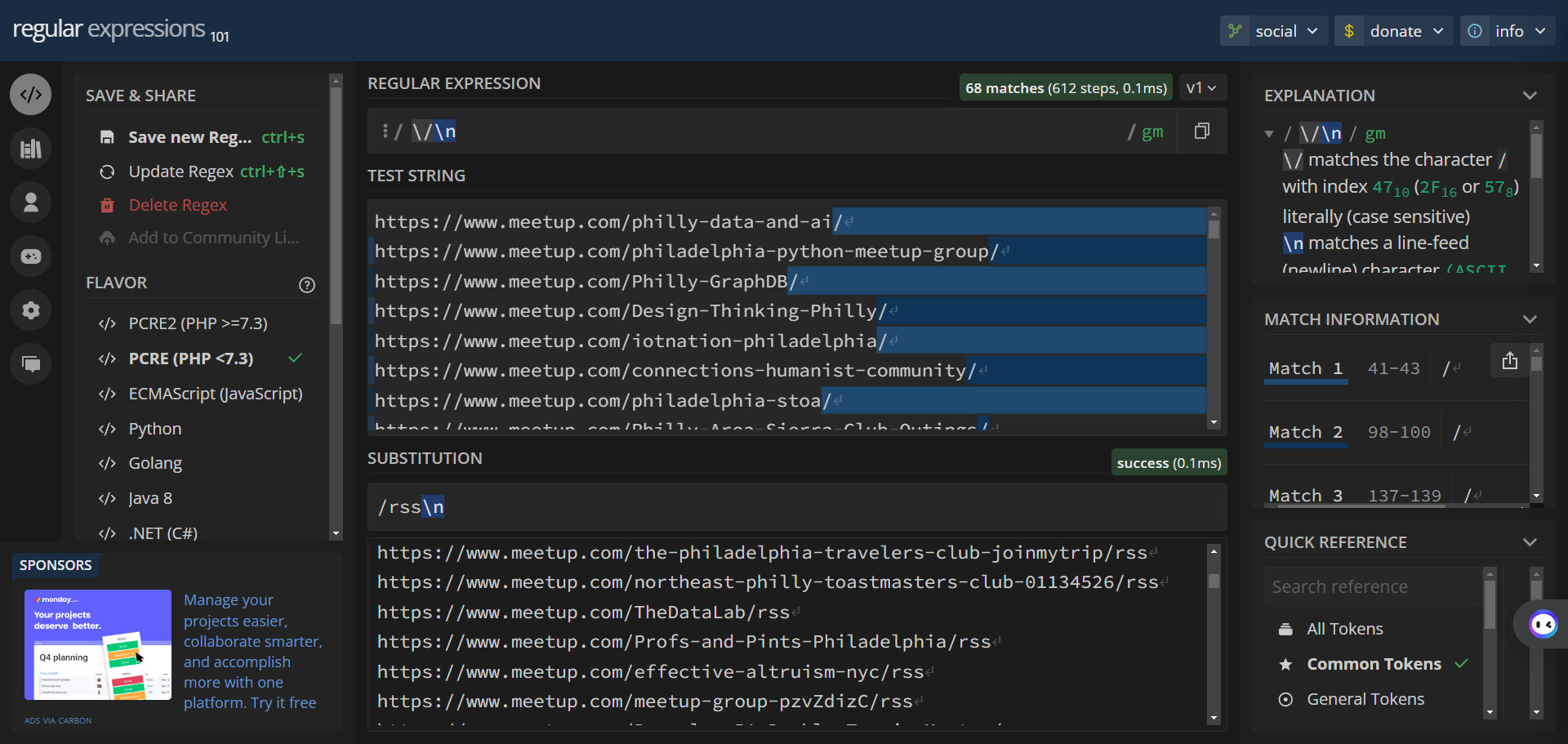
<li>Convert each URL to RSS using <code>regex</code>:<!-- -->
<ol>
<li>Open <strong><a href="https://regex101.com/" target="_blank" rel="noopener noreferrer">Regex101</a></strong> in a new tab.</li>
<li>On the left sidebar, select <strong>Substitution</strong>.</li>
<li>Underneath "Regular Expression", type <code>\/\n</code>.</li>
<li>Underneath "Substition", typ <code>/events/rss\n</code>. This URL corresponds to the RSS feed of the Meetup group's events page.</li>
</ol>
</li>
<li>Copy the new list of URLs into an online <a href="http://opml.org/" target="_blank" rel="noopener noreferrer">OPML</a> generator, such as <a href="https://dotriz.com/tools/opml-generator/" target="_blank" rel="noopener noreferrer">Riz Tools OPML Generator</a>.</li>
<li>Generate an <code>.opml</code> file using the site. The site may also return an <code>.xml</code> file - this is fine to use as well.</li>
<li>Import the <code>.opml</code> into your RSS reader.</li>
</ol>
<p><img decoding="async" loading="lazy" alt="Convert Meetup event URLs to RSS feeds" src="https://quinnmchugh.net/assets/images/regex-101-convert-meetup-event-urls-to-rss-18587e88276255eab7f652d76f4d4aa1.png" width="1920" height="911" class="img_ev3q"></p>]]></content>
        <author>
            <name>Quinn McHugh</name>
        </author>
        <category label="RSS" term="RSS"/>
        <category label="Community" term="Community"/>
        <category label="Personal Information Management (PIM)" term="Personal Information Management (PIM)"/>
    </entry>
    <entry>
        <title type="html"><![CDATA[Being bored requires practice]]></title>
        <id>https://quinnmchugh.net/blog-micro/being-bored-requires-practice</id>
        <link href="https://quinnmchugh.net/blog-micro/being-bored-requires-practice"/>
        <updated>2023-06-09T00:00:00.000Z</updated>
        <summary type="html"><![CDATA[There is so much to know in the world and trying to process it all is a Sisyphean task.]]></summary>
        <content type="html"><![CDATA[<p>There is so much to know in the world and trying to process it all is a Sisyphean task.</p>
<p><a href="https://www.quinnmchugh.net/blog-micro/productivity-as-a-personal-health-initiative" target="_blank" rel="noopener noreferrer">Your brain is a muscle that needs rest</a>. Constant input does not necessarily lead to better output.</p>
<p><strong>Being bored is a skill that must be practiced, not a state that must be avoided.</strong></p>]]></content>
        <author>
            <name>Quinn McHugh</name>
        </author>
        <category label="Mental Health" term="Mental Health"/>
        <category label="Creativity" term="Creativity"/>
        <category label="Knowledge" term="Knowledge"/>
    </entry>
    <entry>
        <title type="html"><![CDATA[LLMs: Translators of languages no human can understand]]></title>
        <id>https://quinnmchugh.net/blog-micro/llms-as-translators</id>
        <link href="https://quinnmchugh.net/blog-micro/llms-as-translators"/>
        <updated>2023-06-01T00:00:00.000Z</updated>
        <summary type="html"><![CDATA[I recently came across this great introductory talk from the Center for Humane Technology, discussing the less catastrophic, but still significant risks of generative large language models (LLMs). This might be a valuable resource to share with those unfamiliar with the staggering pace of AI capabilities research.]]></summary>
        <content type="html"><![CDATA[<p>I recently came across <a href="https://youtu.be/xoVJKj8lcNQ" target="_blank" rel="noopener noreferrer">this great introductory talk</a> from the Center for Humane Technology, discussing the less catastrophic, but still significant risks of generative large language models (LLMs). This might be a valuable resource to share with those unfamiliar with the staggering pace of AI capabilities research.</p>
<p><strong>A key insight for me:</strong>
Generative LLMs have the capacity to interpret an astonishing variety of languages. Whether those languages are traditional (e.g. written or verbal English) or abstract (e.g. images, electrical signals in the brain, wifi traffic, etc) doesn't necessarily matter. What matters is the events in that language can be quantified and measured.</p>
<p>While this opens up the door to numerous fascinating applications (e.g. translating animal vocalizations to human language, enabling blind individuals to see), it also raises some serious concerns regarding privacy of thought, mass surveillance, and further erosion of truth, among others.</p>]]></content>
        <author>
            <name>Quinn McHugh</name>
        </author>
        <category label="Productivity" term="Productivity"/>
        <category label="Mental Health" term="Mental Health"/>
    </entry>
    <entry>
        <title type="html"><![CDATA[Productivity as a personal health initiative]]></title>
        <id>https://quinnmchugh.net/blog-micro/productivity-as-a-personal-health-initiative</id>
        <link href="https://quinnmchugh.net/blog-micro/productivity-as-a-personal-health-initiative"/>
        <updated>2023-05-23T00:00:00.000Z</updated>
        <summary type="html"><![CDATA[Creating a productivity system that works for your unique life situation can yield numerous of benefits.]]></summary>
        <content type="html"><![CDATA[<p>Creating a productivity system that works for your unique life situation can yield numerous of benefits.</p>
<p>Benefits such as:</p>
<ul>
<li>Reduced <a href="https://en.wikipedia.org/wiki/Cognitive_load" target="_blank" rel="noopener noreferrer">mental load</a></li>
<li>Reduced <a href="https://en.wikipedia.org/wiki/Decision_fatigue" target="_blank" rel="noopener noreferrer">decision fatigue</a></li>
<li>Improved <a href="https://dictionary.apa.org/meta-attention" target="_blank" rel="noopener noreferrer">meta-attention</a></li>
</ul>
<p>However, it's too easy to view these systems purely as mechanisms to boost your productivity. That is, viewing them as valuable because they help you "get more stuff done".</p>
<p><strong>To me, these systems aren't only valuable because they increase your individual capacity - they also play an integral role in preserving your cognitive health.</strong> Reducing the clutter your mind has to remember and keep track of is not just a strategy for staying organized; it's a way to care for your brain.</p>
<p>A brain drowning in information is not a healthy brain.</p>
<p>Consider your brain as a muscle. Over-exertion and continuous strain can lead to fatigue and damage, impairing its long-term functionality. So, as you exercise your body for physical health, remember to care for your mental muscle too - it's equally vital, if not more.</p>]]></content>
        <author>
            <name>Quinn McHugh</name>
        </author>
        <category label="Productivity" term="Productivity"/>
        <category label="Mental Health" term="Mental Health"/>
    </entry>
</feed>